NewsAnalysis5 min read
More than half of business rates appeals succeed, VOA figures show
New VOA data shows 57% of businesses that challenged their rates bill secured a reduction — better-than-even odds. But almost 130,000 cases were filed in a single quarter, and the queue is only getting longer.
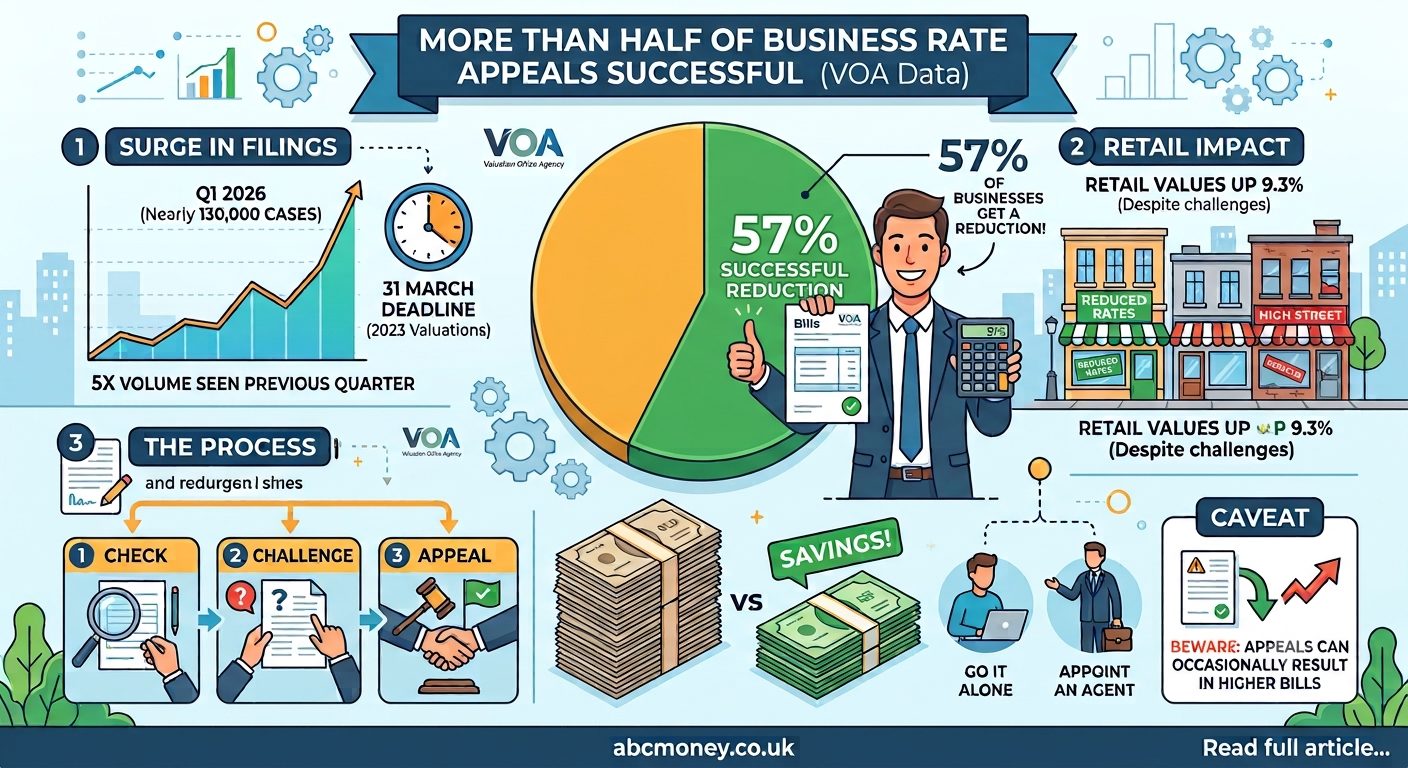
If you've ever looked at your business ratesThe tax most non-residential properties in England pay to their local council, similar to council tax but for shops, offices, warehouses and other business premises. bill and wondered whether it's worth disputing, the Valuation Office AgencyThe government body that sets every property's Rateable Value. From April 2026 the VOA is part of HMRC (see below), but 'VOA' is still the common name for the valuation side of the work.'s own statistics — published at the end of May 2026 — answer the question fairly directly: 57% of businesses that challenged their bill eventually secured a reduction. That's better than even odds, from the body that decides the outcome.
A five-fold surge in filings
Almost 130,000 businesses began the process in the first three months of 2026 alone — five times the volume seen in the final quarter of 2025. Much of that rush was driven by the 31 March 2026 deadline for challenging valuations on the 2023 rating list. That door has now closed; the 2026 list is the one open to challenge.
The practical consequence of a 130,000-case queue is delay. Every case filed this year sits behind that backlog, which is a straightforward argument for starting sooner rather than later.
Why so many people are looking — retail especially
The 2026 revaluationThe periodic exercise where the VOA updates every property's Rateable Value to reflect current rents. The most recent revaluation took effect 1 April 2026. reset every property's Rateable Value (RV)The official estimate of a property's annual rental value on a fixed valuation date. Your rates bill is based on this figure, not on what you actually pay in rent. from 1 April 2026. Retail took a harder hit than most: analysis by Ryan puts the overall increase in retail rateable values across England and Wales at 9.3%. That happened even as the high street shrank — the same analysis found a net loss of 4,410 retail premises since November 2022, equivalent to more than 28 units a week disappearing.
Higher valuations applied to a contracting sector is exactly the combination that produces assessments worth questioning.
How the process actually runs
Disputing a valuation runs in three stages — Check, Challenge, AppealThe three-stage official process for disputing your Rateable Value: 'Check' the facts held about your property, 'Challenge' the valuation with evidence, then 'Appeal' to an independent tribunal if it's still unresolved.. A Check simply asks the VOA to confirm the facts it holds about your property; if there's a wrong floor area or an incorrect use classification in the system, a Check alone can fix it. Relatively few Checks produce a reduction on their own, so most businesses go on to Challenge, which is where evidence does the work: open-market rent, comparableA similar nearby property used as evidence for what your Rateable Value should be. Good comparables share your property's type, size band and location. leases nearby, or a material change to your property or the surrounding area. Cases that don't succeed at Challenge can go to the independent Valuation Tribunal, which charges a fee of up to £300 — refunded if you win.
Note the sequencing: the clock on your Challenge only starts once your Check is settled, so any delay in filing the Check compresses the time you have left to build the case that actually matters.
The caveat nobody advertises
An appeal can result in a higher bill, not a lower one. It's uncommon, but the VOA can revise its estimate upward if your evidence suggests the current valuation is too low. This is the reason to look at your numbers properly before you file anything — not after.
Where to start
Before committing to a process that takes months, it's worth knowing whether you have a case at all. The quickest test is comparing your rate per square metreThe value per square metre used to build up a property's Rateable Value. Comparing your £/m² rate to similar nearby properties is the main way to check whether your RV looks too high. against similar nearby properties valued on the same basis. That's what Business Rate Checker does automatically — enter your postcode and see how your property compares to comparable premises nearby, free, in about two minutes.
What this means for you
The quickest way to know whether any of this affects your own bill is to compare your rateable value with genuinely similar properties nearby. Free, about two minutes, no account.
Check my ratesSources
Independent service — not endorsed by the VOA or HMRC. We use published rating-list data under licence; official rateable values and formal decisions come only from the VOA/HMRC. England only.