NewsAnalysis5 min read
Small Business Requests to Challenge HMRC Data Have Exploded Since April's Rate Hike
VOA data shows requests to correct property records have rocketed from almost nothing in April to over 700 a week by July — and more than four in five have been accepted in full. Here's what's driving the surge, and what it means for your own rates bill.
When the new 2026 Rating ListThe public register listing every business property's Rateable Value. The current list is the '2026 list', based on rental values from 1 April 2024. came into force on 1 April 2026, most business owners expected their bill to change. What almost nobody expected was what happened next.
Our analysis of every VOAThe government body that sets every property's Rateable Value. From April 2026 the VOA is part of HMRC (see below), but 'VOA' is still the common name for the valuation side of the work. update published since the new list came into effect shows that requests for formal ChecksThe three-stage official process for disputing your Rateable Value: 'Check' the facts held about your property, 'Challenge' the valuation with evidence, then 'Appeal' to an independent tribunal if it's still unresolved. have exploded — rising from virtually nothing in April to between 600 and 700 a week in July. That's not a gradual increase. It's an almost vertical curve.
For businesses paying rates, this matters because a Check is usually the first sign that a ratepayer believes something about their property record may be wrong — or that they intend to dispute their valuation.
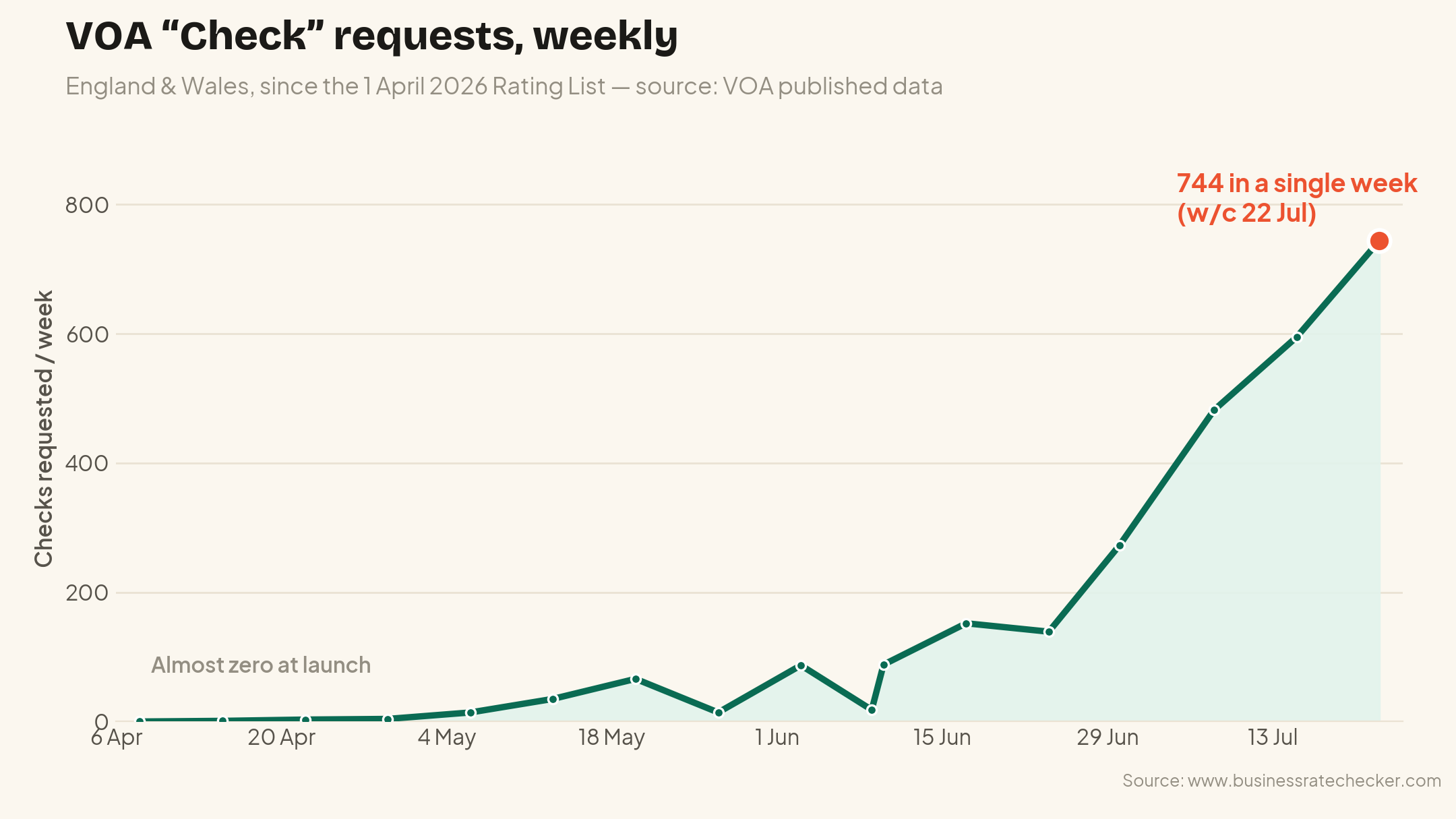
The trajectory tells its own story. Check activity was almost non-existent immediately after the new Rating List was introduced, rising to under 100 a week in May, climbing to between 100 and 200 a week in June, and then exploding to more than 700 a week in July.
What is a VOA Check?
Many people assume a Check is simply a business asking for a lower Rateable ValueThe official estimate of a property's annual rental value on a fixed valuation date. Your rates bill is based on this figure, not on what you actually pay in rent.. It isn't. A Check is about facts, not value — think of it as asking the VOA: “the information you hold about my property isn't correct.”
Typical issues include:
- Incorrect floor area
- Wrong number of rooms or toilets
- Incorrect description of the property
- Incorrect address
- Changes to the building that haven't been reflected
Only after the Check has completed can a business move on to the next stage and formally argue that the valuation itself is wrong. The process runs in three steps:
- Check – are the property facts correct?
- Challenge – is the valuation correct?
- Appeal – if agreement still cannot be reached.
Why have Checks suddenly increased?
There are probably several reasons.
1. The new Rating List prompted businesses to look more closely
The April 2026 Rating List introduced new Rateable Values across England. Many businesses reviewed their assessment for the first time in years and started comparing it with their premises — and that naturally uncovers errors.
2. Businesses are preparing to challenge their valuations
Because a Check is compulsory before a Challenge can be made, today's Check numbers are effectively tomorrow's Challenge pipeline. Businesses that believe their valuation is excessive have to start here.
3. Professional advisers are becoming active
Many rating surveyors and specialists wait until the new list has settled before reviewing portfolios. As more advisers work through client properties, more Checks get submitted.
A Check isn't always about floor space
Correcting floor space is probably the most common reason for a Check, but there are several other legitimate triggers, including:
- Extensions or alterations
- Splitting one property into several units
- Merging multiple units together
- Change of use — for example, a shop becoming a café
- Physical changes nearby that affect the property
- Correcting errors made by the VOA itself
In other words, a Check is about ensuring the VOA is working from accurate information.
The good news: most Checks succeed
One of the most interesting findings in the VOA data is how often businesses succeed. Since April:
- 2,243 Checks were fully agreed
- 472 were partially agreed
- None were rejected outright
That means more than four out of every five Checks were accepted in full, with the remainder resulting in at least some factual correction. The evidence suggests that if the facts are wrong, the VOA is generally willing to correct them.
Why this matters for your business rates
Your business ratesThe tax most non-residential properties in England pay to their local council, similar to council tax but for shops, offices, warehouses and other business premises. bill starts with the information held by the VOA. If that information is incorrect, everything built on it may also be incorrect — which is why it's worth periodically reviewing:
- Your Rateable Value (RV)
- Total floor area
- Property description
- Address
- Layout of the premises
- Whether recent building works have been reflected
Even relatively small factual errors can affect how a property is valued. You may not ultimately be entitled to a lower Rateable Value — but you should never be paying rates based on incorrect property data.
Don't assume the VOA's records are correct
The dramatic rise in Checks since April shows one thing above all else: thousands of businesses are taking a fresh look at their business rates assessments. If you haven't reviewed yours recently, now is a sensible time to do so.
At Business Rate Checker, we believe every business should understand exactly what information the VOA holds about its property before accepting its bill. Checking your Rateable Value, floor area and property details could be the first step toward paying the right amount — not a penny more than you should. Enter your postcode and see how your property compares to comparable premises nearby, free, in about two minutes.
What this means for you
The quickest way to know whether any of this affects your own bill is to compare your rateable value with genuinely similar properties nearby. Free, about two minutes, no account.
Check my ratesSources
Independent service — not endorsed by the VOA or HMRC. We use published rating-list data under licence; official rateable values and formal decisions come only from the VOA/HMRC. England only.