NewsAnalysis3 min read
Chancellor Healey’s Conference Speech: “First Duty is Fiscal Discipline”
John Healey’s first Labour conference speech as Chancellor was about fiscal discipline and industry. Business rates did not feature, but the Budget on 28 October still could change your bill. Here is what he said and what is reportedly on the table.
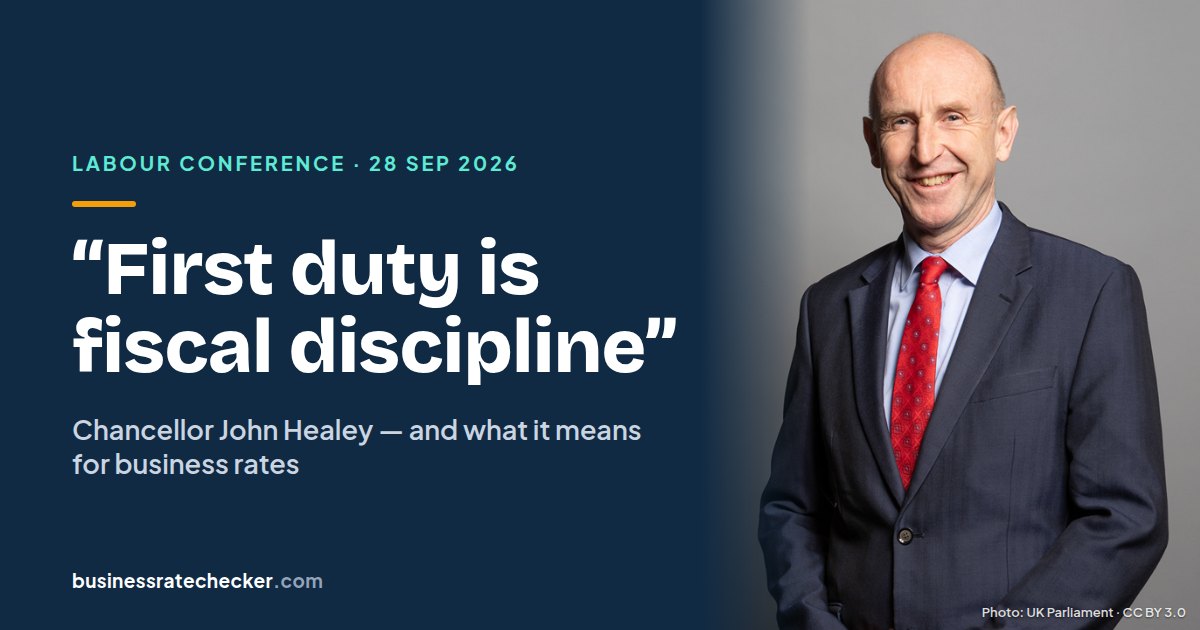
Speaking in Liverpool on 28 September, Chancellor John Healey set out his priorities four weeks before his first Budget. His main theme was a “new age of industrialisation”, with a £6bn plan for new submarine docks on the Clyde. He also recommitted to the government’s fiscal rules, argued for welfare reform, and announced £100m for a new local apprenticeship service.
Why that matters
His message on money was firm. He told delegates that his “first duty is fiscal discipline”, because it “underwrites every promise this government makes”. Any help with business rates in the Budget will have to fit inside that limit. Expect targeted measures, not a general cut.
What is reportedly on the table for 28 October
In the weeks before conference, Treasury officials held workshops with business groups. Press reports suggest the options include:
- A higher Small Business Rate ReliefA discount for smaller properties. Below a certain Rateable Value you pay nothing at all; above that there's a sliding-scale ('tapered') discount up to a higher threshold. threshold. Full relief currently applies up to a rateable value of £12,000 and tapers to nothing at £15,000. The £12,000 threshold hasn’t changed since 2017; one reported option would raise it to £17,096. See what that could save a single shop.
- Longer transitional reliefA cap that phases in large bill increases (or decreases) gradually after a revaluation, so no ratepayer's bill jumps by the full amount in one go.. In 2026/27, bills for properties with a rateable value up to £20,000 (£28,000 in London) can rise by no more than 5%. Extending that protection would slow increases following the 2026 revaluation.
- More help for hospitality. Pubs, social clubs and live music venues already have 15% relief in 2026/27, and a further 20% has been announced on top of that.
None of this is confirmed until the Chancellor stands up on 28 October. Our round-up of every ministerial statement so far has the detail.
What you can do now
Every relief depends on one number: your rateable valueThe official estimate of a property's annual rental value on a fixed valuation date. Your rates bill is based on this figure, not on what you actually pay in rent., set by the Valuation Office. If the relief threshold rises, whether your value sits just above or just below it will matter more than ever. A value that is too high could cost you relief you would otherwise qualify for.
- Check your rateable value against similar properties nearby. Run a free check.
- Make sure you have claimed Small Business Rate Relief if you are eligible. It is not automatic. See our guide to business rate reliefs.
We will cover what the Budget means for small businesses on 28 October.
What this means for you
The quickest way to know whether any of this affects your own bill is to compare your rateable value with genuinely similar properties nearby. Free, about two minutes, no account.
Check my ratesSources
- Left Foot Forward — John Healey tells Labour conference welfare bill is “not progressive”, 28 September 2026
- Bloomberg — Healey says hope for Britons is earned through fiscal discipline, 28 September 2026
- LabourList — Chancellor John Healey to pledge ‘new age of industrialisation’, 27 September 2026
- London Loves Business — Healey weighs business rates cuts to revive England’s high streets
- Photo: official portrait of John Healey MP, UK Parliament, CC BY 3.0 (cropped and placed on a graphic)
Independent service — not endorsed by the VOA or HMRC. We use published rating-list data under licence; official rateable values and formal decisions come only from the VOA/HMRC. England only.