NewsAnalysis5 min read
Business rates before the Budget: three things to check now
The Budget on 28 October can change the multiplier and the reliefs, from April 2027 at the earliest. It cannot change the number your bill is built on: your rateable value. Here are the three things worth checking before the Chancellor stands up, and why none of them wait for the Budget.
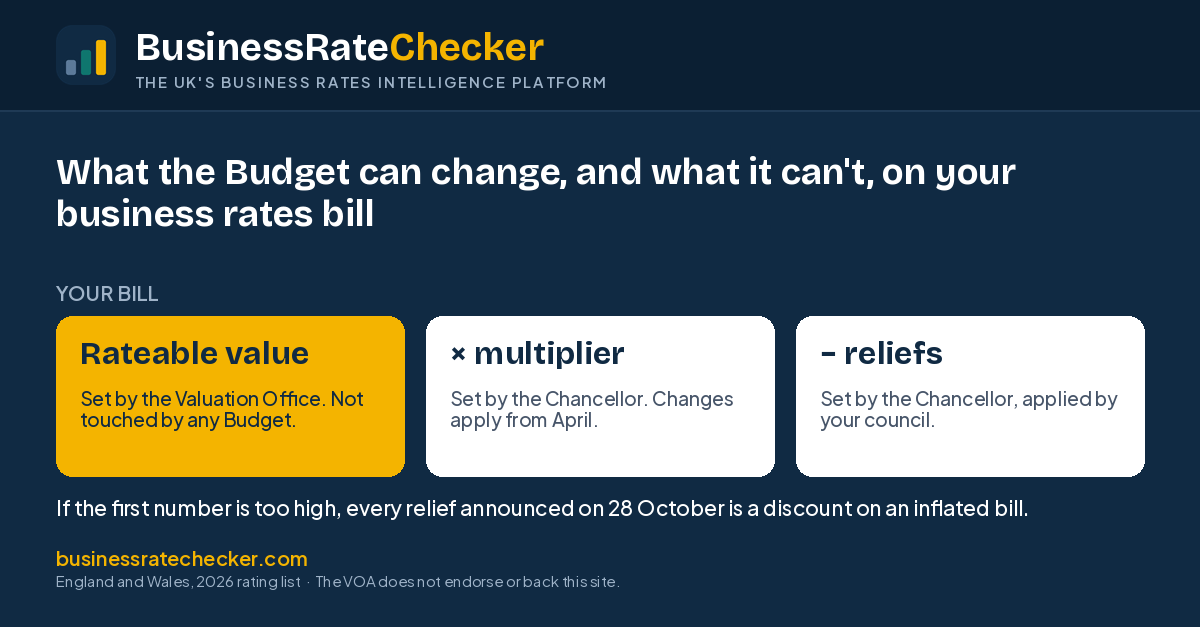
The Budget is on Wednesday 28 October, and business ratesThe tax most non-residential properties in England and Wales pay to their local council, similar to council tax but for shops, offices, warehouses and other business premises. are expected to feature. Whatever is announced will take effect from April 2027 at the earliest, may be amended before then, and will not change the one number every bill starts from. Your bill is your rateable valueThe official estimate of a property's annual rental value on a fixed valuation date. Your rates bill is based on this figure, not on what you actually pay in rent. multiplied by the multiplierThe pence-in-the-pound rate the government sets each year. Your rates bill is roughly Rateable Value × multiplier, before any reliefs are applied., less any reliefs. The Chancellor sets the second and the third. The Valuation OfficeThe government body that sets every property's Rateable Value. From April 2026 the VOA is part of HMRC (see below), but 'VOA' is still the common name for the valuation side of the work. sets the first, and no Budget touches it. If that number is too high, every relief announced next week is a discount on an inflated bill.
So the three things worth checking before the 28th are the three things the Budget leaves alone. All three take about ten minutes, and none of them involve filling in a form.
1. Your rateable value, next to your neighbours'
Your rateable value is public, and so is everyone else's. The Valuation Office publishes the 2026 rating listThe public register listing every business property's Rateable Value. The current list is the '2026 list', based on rental values from 1 April 2024. for England and Wales, and a property's value is meant to sit in line with similar premises nearby, valued on the same basis. What the public list does not do is put them side by side. We have run every property on the list through the same comparison: the same valuation scheme, the same use class, within about a kilometre. On that screen, roughly one business property in ten is flagged as paying more than comparableA similar nearby property used as evidence for what your Rateable Value should be. Good comparables share your property's type, size band and location. premises nearby, and the median indicative saving on a flagged property is £713 a year before reliefs. In some councils the share is above one in five; in others it is under one in twenty.
That is a screen, not a valuation. A high reading means the number deserves a closer look, not that it is wrong. But it is the look most owners never take, and it is the only one of the three that depends on where you are rather than on what you were told.
2. Whether small business rate relief is on your bill
Small business rate reliefA discount for smaller properties. Below a certain Rateable Value you pay nothing at all; above that there's a sliding-scale ('tapered') discount up to a higher threshold. is the one relief that most small premises in England qualify for, and it is the one most often missing. At a rateable value of £12,000 or less it removes the bill entirely; between £12,001 and £15,000 it tapers to nothing. It normally requires you to occupy one property, and it is not applied automatically: you claim it from your council, and the council decides. If your value is in that band and your bill shows no relief line, that is a question for the council, and it does not need a Budget to answer it.
Two details that catch people. First, there is no lower multiplier for small properties; small premises pay less because of the relief, not a different rate, so losing the relief is the whole difference. Second, crossing £15,000 is not a cliff edge, because the taper reaches zero there. The real steps are at £51,000 and £500,000, where the multiplier bands change.
3. Your floor area, on two documents that should agree
A rateable value is mostly area multiplied by a rate per square metre, so the area on the rating list matters as much as the rate. Most business premises also have an Energy Performance Certificate, and the certificate records a floor area too. The two are measured differently, and a certificate normally reads larger than the rating list, not smaller. When it reads materially smaller, one of the two documents is wrong about the size of your premises, and if it is the rating list, the value is overstated by roughly the same proportion. One Bradford unit on our system is rated on 683.6 m²; its certificate, lodged in 2019, records 376 m². We cross-check the two for every property that has a certificate, because nobody else does.
Correcting a factual error of that kind is what a CheckThe three-stage official process for disputing your Rateable Value: 'Check' the facts held about your property, 'Challenge' the valuation with evidence, then 'Appeal' to an independent tribunal if it's still unresolved. is for. It is the first stage of the Valuation Office's process, it is about facts rather than opinion, and it is a step you choose to take; we do not take it for you.
Values do move
Since the 2026 list came into force in April, 7,223 Checks have altered it, across 316 councils in England and Wales. Where the before and after can be measured, 1,300 values were cut. Those are cases that changed the list; a refused Check never appears in the Valuation Office's data, so the figures are not a success rate. They do show one thing worth knowing before you act: values are corrected every week, and the correction starts with a fact about the property. Where a value is cut, the lower figure is backdatedIf a challenge succeeds, the lower Rateable Value is usually applied from when the list started (or when the issue arose), so you can reclaim the difference for the period already paid. to the start of the list.
What happens on the 28th, and what doesn't
On Budget day we will publish what was announced for small business premises in plain words, with the dates it takes effect. The figures on this site will not change that day, because the figures that apply to your bill will not change that day either. The number that applies now, and will still apply after the Budget, is the one on the list. Checking it takes a postcode and a minute.
What this means for you
The quickest way to know whether any of this affects your own bill is to compare your rateable value with genuinely similar properties nearby. The summary is free and takes about two minutes.
Check my ratesSources
Independent service — not endorsed by the VOA or HMRC. We use published rating-list data under licence; official rateable values and formal decisions come only from the VOA/HMRC. England only.