NewsAnalysis6 min read
Budget Preview: Small Business Rate Relief Threshold May Rise to £18,000 as Healey Drops the Warehouse Tax, Reports Say
Five weeks on from our first look at the Budget, the reported small business rate relief threshold has moved up to £18,000, the warehouse tax that was meant to pay for it has been dropped, and a £1.1bn inflation rise for multipliers is waiting for April. Here is what the evidence points to for Wednesday, and what our own figures say it would cost.
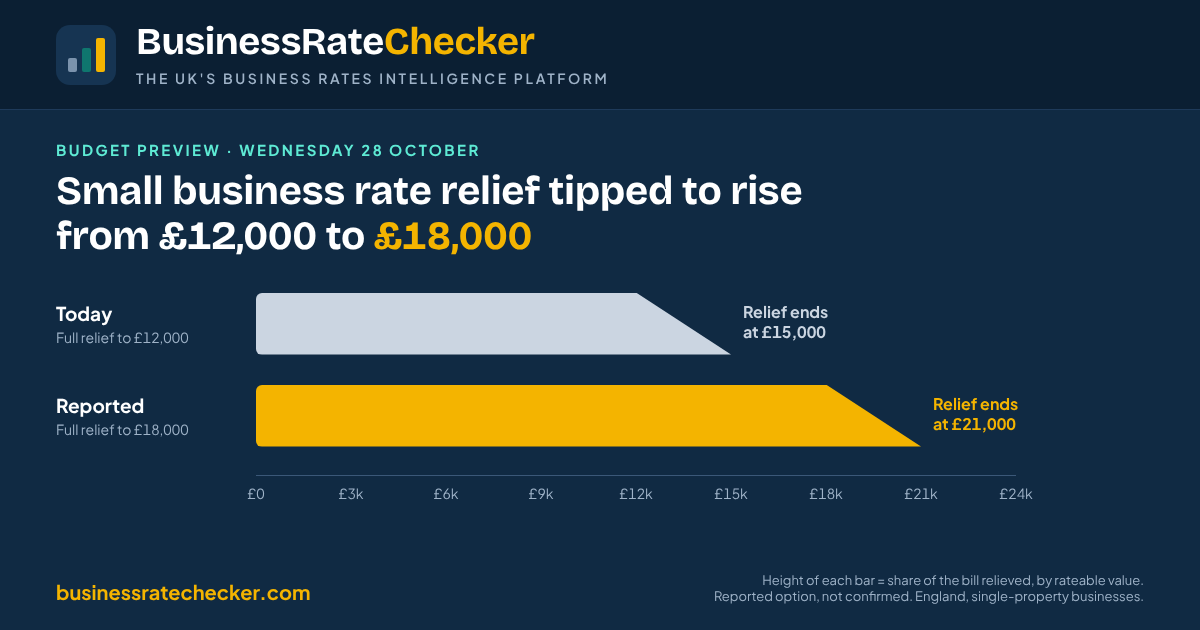
On 19 September we wrote that Andy Burnham’s government was weighing up to £1bn of business rate cuts for its first Budget. With two days to go before John Healey stands up on Wednesday 28 October, the shape of that package is clearer, and two of our September assumptions have changed. The threshold being reported is higher than it was, and the way of paying for it is different.
Nothing below is confirmed. The Treasury’s line, given to City AM on 14 October, is that “decisions on tax are a matter for the chancellor to set out at fiscal events.” But the briefing has been consistent enough over the last five weeks to say what is likely, what is possible and what has been ruled out.
What has changed since September
- The reported Small Business Rate ReliefA discount for smaller properties. Below a certain Rateable Value you pay nothing at all; above that there's a sliding-scale ('tapered') discount up to a higher threshold. threshold has moved from about £17,000 to £18,000, with relief tapering to nothing at £21,000 rather than £20,000.
- The warehouse tax is off. In September the Prime Minister talked about making large warehouses pay more; on 10 October The Telegraph reported that the Chancellor had ruled it out.
- Online marketplaces are now the reported funding source, through a change to how VAT is collected on platforms such as Amazon, eBay and Temu, said to be worth up to £1bn.
- A £1.1bn rise is waiting for April as multipliers increase. September’s inflation figure, 3.5%, sets next year’s multipliers unless the Chancellor intervenes.
The threshold: £18,000 is now the number
Radio station LBC reported on 18 October that the Chancellor is expected to lift the point at which businesses start paying from a rateable valueThe official estimate of a property's annual rental value on a fixed valuation date. Your rates bill is based on this figure, not on what you actually pay in rent. of £12,000 to £18,000, applying in England first. The Sunday Times put the number of properties taken out of business rates entirely at about 75,000, based on independent analysis of around £460m a year in liabilities. LBC broke the beneficiaries down as 40,000 shops, more than 2,500 pubs, 2,000 salons, 1,600 cafés and 1,600 village halls, and reported that Mr Burnham has floated taking the threshold to £21,000 over time. The British Beer and Pub Association estimates that an £18,000 threshold would take about 5,000 pubs out of business rates.
The £12,000 threshold has not moved since 2017. Raising it in line with inflation since then would take it to about £17,100, which is where September’s reports started. £18,000 goes a little beyond that.
What it would cost: our updated estimate
We hold the full England rating listThe public register listing every business property's Rateable Value. The current list is the '2026 list', based on rental values from 1 April 2024., so we have re-run September’s estimate on today’s list for both versions of the change. The method is the same as before: every property in the affected band, billed at the 43.2p small business multiplierThe pence-in-the-pound rate the government sets each year. Your rates bill is roughly Rateable Value × multiplier, before any reliefs are applied., with the assumption that roughly three in five are occupied by a single-property business and would qualify. That share is our assumption, not a published figure.
| Option | Properties in band | Would qualify (est.) | Annual cost (est.) | Largest gain a year |
|---|---|---|---|---|
| Full relief to £17,000, taper to £20,000Reported in September | 272,939 | 163,800 | £705m | £7,344 |
| Full relief to £18,000, taper to £21,000Reported in October | 294,406 | 176,600 | £826m | £7,776 |
On our figures, about 230,000 English properties sit between £12,000 and £18,000, and would pay nothing if their occupier qualified. The Sunday Times figure of 75,000 is about one in three of those, a lower share than our three in five. The gap matters: if the published analysis is right, many more of these properties are held by businesses with more than one site, and the real cost would sit well below our £826m. Either way, the £18,000 version fits inside the roughly £1bn the marketplace measure is said to raise.
How it would be paid for: online marketplaces, not warehouses
On 1 September the Prime Minister told the Commons that “some of the large entities and warehouses do not, in percentage terms, pay the same amount in business rates.” That idea met resistance from retailers. Jason Tarry, chairman of John Lewis, said a warehouse tax would “reveal a fundamental misunderstanding of how modern high streets work.” Large warehouses already pay the higher 50.8p multiplier introduced in April for properties valued above £500,000.
The replacement, reported by The Times and City AM on 14 October, would make online marketplaces responsible for collecting VAT owed by sellers turning over more than £90,000. Amazon supports it and puts the yield nearer £700m. Dan Neidle of Tax Policy Associates argues the Treasury should go further and “make online marketplaces responsible for collecting every penny of VAT.”
The rise nobody has ruled out
Business rates multipliers rise each April with the previous September’s inflation figure, which came in at 3.5%. Alex Probyn, practice leader for property tax at the tax firm Ryan, said on 21 October that “September’s inflation figure sets the basis for a £1.1bn rise in business rates in England next April, unless the Chancellor intervenes.” Ryan puts £129m of that on hospitality, leisure and accommodation, £206m on retail and £302m on industrial property. Probyn’s test for the Budget is “whether it strengthens the conditions for investment and growth across the business rates system as a whole.”
A freeze has been requested but not trailed. If the multipliers do rise, a business that gains nothing from the threshold change will see its bill go up in April regardless.
What politicians have said
Mr Burnham set the direction on BBC Radio 5 Live on 12 August: “I’m signalling going further on business rates,” adding that “the cost of doing business is too high” but that he is “in a position with limited room for manoeuvre.” Mr Healey has kept to the theme of limited means. At the IMF meetings on 15 October he said “my Budget will protect Britain’s resilience through this turbulent time,” and he has described a Budget “that gives Britain a bit of breathing space.” He met retail, hospitality and small business leaders at Downing Street on 13 October.
The opposition wants more. Andrew Griffith, the shadow chancellor, said the priority should be “shelving Labour’s anti-employment laws, followed closely by business rates relief.” Robert Jenrick, for Reform UK, said “small business owners need a government that stops punishing them for employing people and keeping their doors open.”
Three earlier commitments should also surface on Wednesday: the extra 20% cut for pubs, social clubs and live music venues from April 2027, with detail still due on which large venues are excluded; Emma Reynolds’ fiscal devolution road map, giving councils and mayors more of the business rates they collect from April 2027; and the review of reliefs for businesses “not making a positive contribution to local communities, such as vape shops.” The separate review of how pubs and hotels are valued closed its call for evidence on 16 October and reports by March 2027, for the 2029 revaluationThe periodic exercise where the VOA updates every property's Rateable Value to reflect current rents. The most recent revaluation took effect 1 April 2026..
What business groups are asking for
- British Retail Consortium: freeze the April inflation rise and move shops out of the top band. Chief executive Helen Dickinson: “The choice is clear: ease the burden on retail and unlock investment in the things people care about.”
- Federation of Small Businesses: David Hale called taking small firms out of “this dated tax altogether” an “essential element of a pro-small business budget.” Chair Tina McKenzie: “Ministers say they want growth, but growth does not happen by squeezing margins.”
- UKHospitality: Kate Nicholls wants “restaurants, cafes and hotels” to receive support comparable to pubs.
Rating advisers add a caution that applies to any threshold change. Commercial Property Advisors pointed out on 22 October that an £18,000 threshold would not make every property below it exempt: the single-property rule still applies, and the relief may still have to be claimed from the council.
What to watch for on Wednesday
- The threshold and taper: £18,000 and £21,000, or something smaller, and whether it starts in April 2027.
- The multipliers: a freeze, or the 3.5% inflation rise.
- Transitional relief: whether this year’s 5% cap on increases for smaller properties is extended.
- Who is excluded: the detail on vape shops and the largest music venues.
- Who pays: the marketplace VAT measure, and confirmation that warehouses are left alone.
What it means for you now
Every one of these measures is keyed to your rateable value. If the threshold moves to £18,000, a property valued at £18,500 gets partial relief and one valued at £17,500 pays nothing. That makes the accuracy of the number the Valuation OfficeThe government body that sets every property's Rateable Value. From April 2026 the VOA is part of HMRC (see below), but 'VOA' is still the common name for the valuation side of the work. has given you more valuable than at any time since 2017, and it is the one thing the Budget will not change. Check your rateable value against similar premises nearby, and we will report what the Chancellor actually announces on Wednesday afternoon.
What this means for you
The quickest way to know whether any of this affects your own bill is to compare your rateable value with genuinely similar properties nearby. The summary is free and takes about two minutes.
Check my ratesSources
- BusinessRateChecker — Burnham mulls nearly £1bn of business rate cuts in the October Budget, 19 September 2026
- LBC — Pubs, cafes and high street shops to be spared business rates in Budget overhaul, 18 October 2026
- Commercial Property Advisors — Rates Round Up, 22 October 2026 (citing The Sunday Times)
- The Sunday Times — small business rate relief threshold
- Morning Advertiser — Hospitality faces £129m business rates rise from April 2027 (Ryan), 21 October 2026
- ONS — Consumer price inflation, UK: September 2026, 21 October 2026
- City AM — Healey plans £1bn e-commerce crackdown to fund retail tax breaks, 14 October 2026
- The Telegraph via AOL — Healey rules out warehouse tax raid, 10 October 2026
- Business Matters — Retail bosses warn Healey that tax rises on shops will push up prices, 14 October 2026
- Business Matters — Business rates relief threshold could rise in October Budget, 19 September 2026
- Yorkshire Post — John Healey urged to cut business rates for shops, 10 October 2026
- Morning Advertiser — Chancellor addresses business costs ahead of Autumn Budget, 16 October 2026
- AJ Bell — UK PM says he wants to go 'further' on business rates at the budget, 12 August 2026
- Hansard, Commons — Direction of Government, 1 September 2026
Independent service — not endorsed by the VOA or HMRC. We use published rating-list data under licence; official rateable values and formal decisions come only from the VOA/HMRC. England only.